GATE AE 2024 • Q20 MCQ • 1 Mark Flight Mechanics & Space Dynamics

Flight Mechanics & Space Dynamics

Atmospheric Flight Mechanics

Subtopic: Drag Polar & Aircraft Performance Equations

Question Statement:

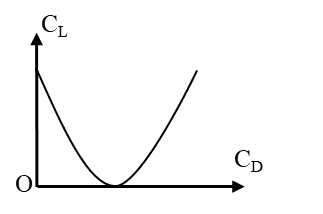
Which one of the following figures represents the drag polar of a general aviation aircraft?
Question figure for GATE AE 2024 Q20

Scientific schematic diagram reproduced from official IIT paper

Options:

  • (A) Figure A: Linear variation ($C_D \propto C_L$)
  • (B) Figure B: Parabola passing through origin ($C_{D0} = 0$)
  • (C) Figure C: Inverted parabola ($d^2C_D/dC_L^2 < 0$)
  • (D) Figure D: Parabola opening to the right with non-zero parasite drag intercept $C_{D0} > 0$

Official Answer Key:

D

Step-by-Step Solution & Explanation

### **Detailed Step-by-Step Solution (GATE AE 2024 Q.20)** **1. Intuitive Physical Setup & Given Parameters**: We are asked to identify the graphical representation of the drag polar ($C_D$ vs $C_L$) for a conventional subsonic aircraft. **2. Step-by-Step Mathematical Derivation**: 1. **Parabolic Drag Polar Formulation**: For a subsonic aircraft at low to moderate angles of attack, the total drag coefficient is expressed as: C_D = C_{D0} + K C_L^2 = C_{D0} + \frac{C_L^2}{\pi e AR} where $C_{D0}$ is the zero-lift parasite drag coefficient, and $K C_L^2$ is the induced (lift-dependent) drag coefficient. 2. **Geometric Properties of the Curve**: - When $C_L = 0$, $C_D = C_{D0} > 0$ (positive intercept on the horizontal $C_D$ axis). - The curve is a parabola symmetric about the horizontal axis (or slightly shifted upward for cambered wings: $C_D = C_{D,\min} + K(C_L - C_{L0})^2$). - $C_D$ increases quadratically with $C_L$. 3. **Graph Identification**: The plot of $C_L$ (vertical axis) versus $C_D$ (horizontal axis) is a parabola opening to the right, originating from $C_D = C_{D0}$ at $C_L = 0$. **3. Comprehensive Options & Distractor Analysis**: - **(A)**: ❌ **INCORRECT**. Shows a straight line ($C_D \propto C_L$). - **(B)**: ❌ **INCORRECT**. Passes through the origin $(0, 0)$, neglecting parasite drag ($C_{D0} = 0$). - **(C)**: ❌ **INCORRECT**. Shows negative curvature ($d^2C_D/dC_L^2 < 0$). - **(D)**: ✅ **CORRECT**. Correct parabolic shape opening to the right with non-zero positive intercept $C_{D0}$. **4. Official Master Key & Exam Takeaway**: - **Official Answer Key**: **D** - **Exam Takeaway**: Drag polar is parabolic: $C_D = C_{D0} + K C_L^2$. A tangent drawn from the origin to the drag polar gives the point of maximum aerodynamic efficiency $(L/D)_{\max}$.
← Previous (Q19) All 2024 Questions Next (Q21) →

Related Atmospheric Flight Mechanics Solved Questions

View All Atmospheric Flight Mechanics PYQs →
GATE AE 2026 Q31 NAT • 1M

An aircraft starts gliding in power-off condition at an altitude of 4 km. Given that the maximum lift to drag ratio of the aircraft is 15, the maximum glide range that the aircraft can cover, measured along the ground, is ________ km (rounded off to the nearest integer).

GATE AE 2026 Q62 NAT • 2M

A gas mixture at a pressure of 800 kPa and a density of 5 kg/m3 enters a turbine stage. The temperature of the gas at the nozzle exit and the stage exit are 790 K and 750 K, respectively. Assume the specific heats are constant for the gas mixture in the range of temperatures considered. The specific heat at constant pressure is 0.72 kJ/kg-K and the ratio of specific heats is 1.33. The value of the degree of reaction of the turbine stage is ________ (rounded off to 2 decimal places).

GATE AE 2025 Q23 MCQ • 1M

For a general aviation airplane, which one of the following has a destabilizing effect on its static roll stability?

GATE AE 2025 Q24 MCQ • 1M

A general aviation airplane is flying at an altitude of 5000 m. The indicated airspeed is 250 km/h. Assume that there are no instrument errors and position errors. Neglecting compressibility effects, which one of the following options is FALSE?

Practice This in Real CBT Exam Interface

Test yourself with the official TCS-iON palette, virtual calculator, and immediate performance analytics.

Launch CBT Mock Test