Question Statement:
The Fourier series representation of a square wave is shown in the figure below.
The fluctuations seen near x = ±1 are named after which one of the following
scientists?
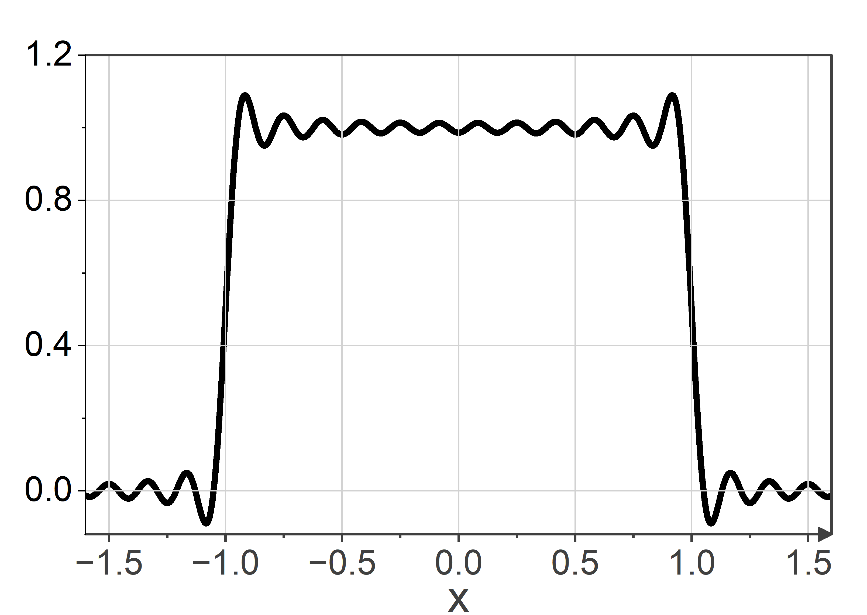
Scientific schematic diagram reproduced from official IIT paper
Options:
-
(A) Cauchy
-
(B) Fourier
-
(C) Gibbs
-
(D) Laplace
Step-by-Step Solution & Explanation
### **Detailed Step-by-Step Solution (GATE AE 2026 Q.12)**
**1. Intuitive Physical Setup & Given Parameters**:
We are shown the Fourier series approximation of a piecewise continuous square wave with jump discontinuities, displaying sharp oscillations and overshoot spikes near the discontinuity.
**2. Step-by-Step Mathematical Derivation**:
1. **Fourier Series Behavior at Jump Discontinuities**:
When a discontinuous function $f(x)$ with a jump discontinuity is approximated by a truncated Fourier series of order $N$, ringing artifacts appear near the jump.
2. **Invariance of Overshoot**:
As $N \to \infty$, the peak overshoot does not vanish; instead, it approaches a fixed limit of approximately $8.95\%$ (about $9\%$) of the jump height on either side:
\lim_{N \to \infty} S_N(x_0^+) - f(x_0^+) = \frac{1}{\pi} \int_0^\pi \frac{\sin t}{t} dt - \frac{1}{2} \approx 0.089490
3. **Historical Attribution**:
This fundamental mathematical behavior was first observed by Henry Wilbraham (1848) and extensively analyzed by the American mathematical physicist J. Willard Gibbs (1899), after whom it is universally known as the **Gibbs phenomenon**.
**3. Comprehensive Options & Distractor Analysis**:
- **(A) Cauchy**: ❌ **INCORRECT**. Associated with the Cauchy residue theorem, Cauchy-Riemann equations, and Cauchy stress tensor.
- **(B) Fourier**: ❌ **INCORRECT**. Fourier developed harmonic analysis, but the discovery of the jump overshoot anomaly is named after Gibbs.
- **(C) Gibbs**: ✅ **CORRECT**. The persistent ~9% overshoot of Fourier partial sums near jump discontinuities is the Gibbs phenomenon.
- **(D) Laplace**: ❌ **INCORRECT**. Associated with Laplace transforms, the potential equation $\nabla^2 \phi = 0$, and celestial mechanics.
**4. Official Master Key & Exam Takeaway**:
- **Official Answer Key**: **C**
- **Exam Takeaway**: The Gibbs overshoot persists regardless of how many harmonics are added ($N \to \infty$). The overshoot width shrinks to zero, but its peak amplitude remains ~8.95% of the half-jump.