Question Statement:
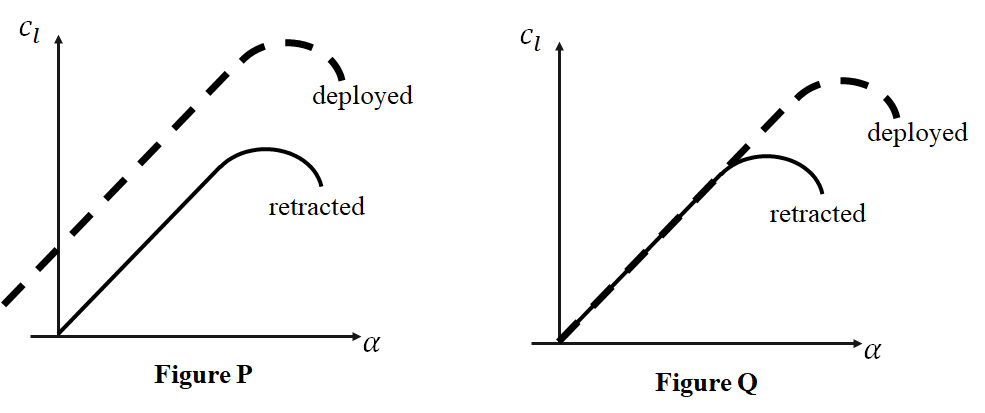
Shown below are qualitative illustrations of the lift curve for an airfoil when two
different control surfaces are in their respective retracted and deployed
configurations. Which of the following is/are TRUE?
Scientific schematic diagram reproduced from official IIT paper
Options:
-
(A) Figure P is for a flap
-
(B) Figure P is for a slat
-
(C) Figure Q is for a slat
-
(D) Figure Q is for a flap
Step-by-Step Solution & Explanation
### **Detailed Step-by-Step Solution (GATE AE 2026 Q.25)**
**1. Intuitive Physical Setup & Given Parameters**:
The problem displays qualitative lift curves ($C_L$ vs $\alpha$) comparing clean configurations with deployed high-lift devices:
- **Figure P**: Deployment shifts the entire linear lift curve upward/to the left without significantly changing the stall angle $\alpha_{\text{stall}}$, yielding a large positive $\Delta C_{L0}$.
- **Figure Q**: Deployment preserves the zero-lift angle of attack $\alpha_{L=0}$ and linear slope, but delays boundary-layer separation, drastically increasing $\alpha_{\text{stall}}$ and $C_{L,\text{max}}$.
We must identify which figure corresponds to a trailing-edge flap and which corresponds to a leading-edge slat (MSQ).
**2. Step-by-Step Aerodynamic Derivation**:
1. **Trailing-Edge Flaps**:
- Deflecting a trailing-edge flap increases the effective camber of the airfoil.
- According to thin airfoil theory, increasing camber shifts the zero-lift angle of attack to a more negative value ($\Delta \alpha_{L=0} < 0$).
- This shifts the $C_L$-$\alpha$ curve vertically upward: higher $C_L$ at every angle of attack, but $\alpha_{\text{stall}}$ remains similar or slightly decreases due to adverse pressure gradients.
- This signature matches **Figure P**.
2. **Leading-Edge Slats**:
- A leading-edge slat introduces high-momentum air into the upper-surface boundary layer through a slot, energizing the flow and delaying separation.
- Slats do not change the basic camber or zero-lift angle of attack significantly at low $\alpha$.
- Instead, they allow the airfoil to operate at much higher angles of attack before stalling (increasing $\alpha_{\text{stall}}$ significantly, e.g. from $14^\circ$ to $22^\circ$).
- This signature matches **Figure Q**.
3. Therefore, Figure P represents a **flap** and Figure Q represents a **slat**.
**3. Comprehensive Options & Distractor Analysis**:
- **(A) Figure P is for a flap**: ✅ **CORRECT**. Flaps increase camber, shifting the lift curve up ($\Delta C_L$ increment at fixed $\alpha$).
- **(B) Figure P is for a slat**: ❌ **INCORRECT**. Slats do not shift the linear $C_L$ intercept at zero angle of attack.
- **(C) Figure Q is for a slat**: ✅ **CORRECT**. Slats delay boundary layer stall to much higher angles of attack.
- **(D) Figure Q is for a flap**: ❌ **INCORRECT**. Flaps typically decrease or maintain the stall angle, not extend it dramatically.
**4. Official Master Key & Exam Takeaway**:
- **Official Answer Key**: **A, C**
- **Exam Takeaway**: Trailing-edge flaps increase effective camber (vertical lift curve shift); leading-edge slats control boundary layer separation (horizontal extension of linear range and increased stall angle).