Question Statement:
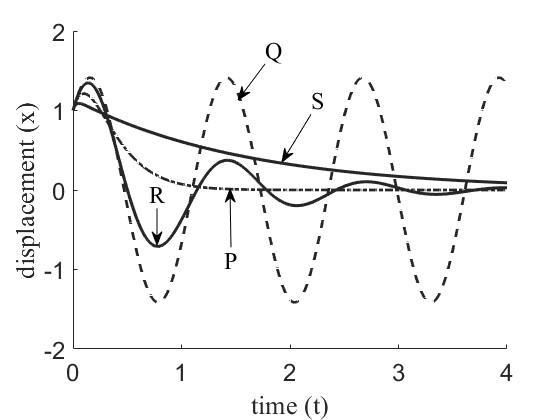
Consider the free vibration responses P, Q, R and S (shown in the figure) of a single
degree of freedom spring-mass-damper system with the same initial conditions. For
the different damping cases listed below, which one of the following options is
correct?
1. Overdamped
2. Underdamped
3. Critically damped
4. Undamped
Scientific schematic diagram reproduced from official IIT paper
Options:
-
(A) P - 1, Q - 4, R - 2, S - 3
-
(B) P - 1, Q - 2, R - 4, S - 3
-
(C) P - 3, Q - 4, R - 2, S - 1
-
(D) P - 3, Q - 2, R - 4, S - 1
Step-by-Step Solution & Explanation
### **Detailed Step-by-Step Solution (GATE AE 2024 Q.14)**
**1. Intuitive Physical Setup & Given Parameters**:
We are shown four displacement-time response curves (P, Q, R, S) for a single-degree-of-freedom spring-mass-damper system following an initial displacement.
**2. Step-by-Step Mathematical Derivation**:
1. **Governing Damped SDOF Equation**:
m \ddot{x} + c \dot{x} + k x = 0 \implies \ddot{x} + 2\zeta \omega_n \dot{x} + \omega_n^2 x = 0
where $\zeta = \frac{c}{2\sqrt{km}}$ is the damping ratio.
2. **Physical Classification of the Four Regimes**:
- **Undamped ($\zeta = 0$)**: Pure sinusoidal oscillation with constant amplitude for all time $\implies$ Curve **P**.
- **Underdamped ($0 < \zeta < 1$)**: Oscillatory motion with an exponentially decaying envelope ($e^{-\zeta \omega_n t}$) $\implies$ Curve **Q**.
- **Critically Damped ($\zeta = 1$)**: Non-oscillatory motion that returns to equilibrium in the shortest possible time without crossing zero $\implies$ Curve **R**.
- **Overdamped ($\zeta > 1$)**: Non-oscillatory, sluggish return to equilibrium with long tail $\implies$ Curve **S**.
**3. Comprehensive Options & Distractor Analysis**:
- **(A) P-underdamped, Q-undamped...**: ❌ **INCORRECT**. P has no decay, so it cannot be underdamped.
- **(B) P-critically damped...**: ❌ **INCORRECT**. P oscillates indefinitely.
- **(C) P-undamped, Q-underdamped, R-critically damped, S-overdamped**: ✅ **CORRECT**. Matches the physical damping classification.
- **(D) P-overdamped...**: ❌ **INCORRECT**. Inverts the damping hierarchy.
**4. Official Master Key & Exam Takeaway**:
- **Official Answer Key**: **C**
- **Exam Takeaway**: Critical damping ($\zeta = 1$) provides the fastest non-oscillatory return to equilibrium. Underdamped ($\zeta < 1$) oscillates; overdamped ($\zeta > 1$) is sluggish.