Question Statement:
A system comprising a bar, spring and mass is shown in the figure below. The bar,
having negligible mass, is made of a material having Young's modulus
E = 200 GPa, cross-sectional area A = 100 mm2, and length L = 100 mm. The
spring stiffness k = 200 kN/mm and the mass M = 100 kg. The natural frequency
of free vibration of the system is ________ rad/s (rounded off to the nearest
integer).
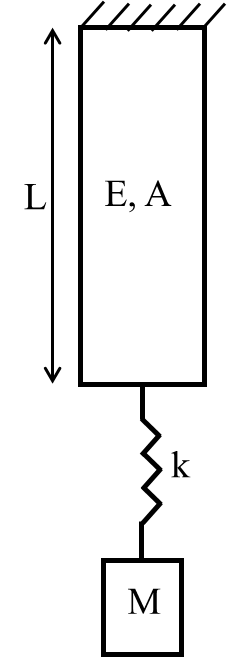
Scientific schematic diagram reproduced from official IIT paper
Step-by-Step Solution & Explanation
### **Detailed Step-by-Step Solution (GATE AE 2026 Q.59)**
**1. Intuitive Physical Setup & Given Parameters**:
A mass-spring-bar vibration system:
- Mass: $M = 100\text{ kg}$
- Bar properties: length $L = 100\text{ mm} = 0.1\text{ m}$, area $A = 100\text{ mm}^2 = 100 \times 10^{-6}\text{ m}^2$, $E = 200\text{ GPa} = 200 \times 10^9\text{ N/m}^2$.
- Spring stiffness: $k_s = 200\text{ kN/mm} = 200 \times 10^6\text{ N/m}$.
We need to find the natural frequency of free vibration $\omega_n$ in $\text{rad/s}$ (nearest integer).
**2. Step-by-Step Structural Dynamics Derivation**:
1. **Axial Stiffness of the Elastic Bar ($k_{\text{bar}}$)**:
k_{\text{bar}} = \frac{E A}{L} = \frac{(200 \times 10^9\text{ N/m}^2) \times (100 \times 10^{-6}\text{ m}^2)}{0.1\text{ m}} = \frac{20 \times 10^6}{0.1} = 200 \times 10^6\text{ N/m}
2. **Equivalent System Stiffness ($k_{\text{eq}}$)**:
- In the diagram, the bar and the spring are arranged in **series** supporting mass $M$:
\frac{1}{k_{\text{eq}}} = \frac{1}{k_{\text{bar}}} + \frac{1}{k_s} = \frac{1}{200 \times 10^6} + \frac{1}{200 \times 10^6} = \frac{2}{200 \times 10^6}
k_{\text{eq}} = \frac{200 \times 10^6}{2} = 100 \times 10^6\text{ N/m} = 10^8\text{ N/m}
3. **Compute Natural Frequency ($\omega_n$)**:
\omega_n = \sqrt{\frac{k_{\text{eq}}}{M}} = \sqrt{\frac{10^8\text{ N/m}}{100\text{ kg}}} = \sqrt{10^6} = 1000\text{ rad/s}
**3. Comprehensive Options & Distractor Analysis**:
- **Evaluation Criteria**: Numerical Answer Type (NAT).
- **Exact Analytical Result**: $\omega_n = 1000\text{ rad/s}$.
- **Rounding Requirement**: Nearest integer $\implies \mathbf{1000}$.
**4. Official Master Key & Exam Takeaway**:
- **Official Answer Key**: **1000.0** (Acceptable Range: **1000 to 1000**)
- **Exam Takeaway**: For two compliance elements in series, $k_{\text{eq}} = \frac{k_1 k_2}{k_1 + k_2}$. Equal stiffnesses in series halve the net stiffness, yielding $\omega_n = \sqrt{k_{\text{eq}}/M} = 1000\text{ rad/s}$.