Question Statement:
Consider the flow over an oval modeled using the elementary potential flows as
shown below. U represents uniform flow velocity and $\Gamma$ represents circulation
around an irrotational line vortex.
Which of the following statements is/are TRUE for this model?
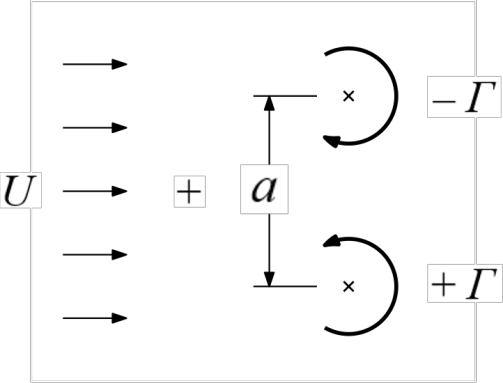
Scientific schematic diagram reproduced from official IIT paper
Options:
-
(A) Increasing U enlarges the oval
-
(B) Increasing $\Gamma$ enlarges the oval
-
(C) Interchanging the sense of the two vortices does not alter the oval
-
(D) Moving the vortices too far apart causes the oval to break up
Step-by-Step Solution & Explanation
### **Detailed Step-by-Step Solution (GATE AE 2026 Q.47)**
**1. Intuitive Physical Setup & Given Parameters**:
An oval body (Rankine-like oval) is synthesized in 2D potential flow using elementary flows:
- Uniform freestream of velocity $U$.
- A vortex pair consisting of two counter-rotating irrotational line vortices of circulation $\pm \Gamma$ separated by distance $2d$.
We are asked to identify which statements are **TRUE** regarding this flow model (MSQ).
**2. Step-by-Step Potential Flow Derivation**:
1. **Governing Stream Function & Stagnation Points**:
- The stream function is obtained by superposing uniform flow and the vortex pair:
\psi = U y + \frac{\Gamma}{2\pi} \ln(r_1) - \frac{\Gamma}{2\pi} \ln(r_2)
- The closed dividing streamline $\psi = 0$ defines the boundary of the closed oval body.
- Stagnation points occur where velocity $\vec{V} = \nabla\phi = 0$.
2. **Effect of Parameter Variations**:
- **Increasing Freestream Velocity $U$**: Increasing $U$ compresses the streamlines closer to the vortex centers, shrinking the closed dividing streamline. Statement A is **FALSE**.
- **Increasing Circulation $\Gamma$**: Increasing vortex strength $\Gamma$ induces stronger opposing velocities further out, pushing the stagnation points further away and **enlarging the oval**. Statement B is **TRUE**.
- **Interchanging Sense of Vortices**: Reversing the signs of $\Gamma$ reverses the induced velocity direction (from opposing freestream to assisting it, or flipping stagnation points), which alters the stagnation streamline and shape. Statement C is **FALSE**.
- **Vortex Separation Distance**: If the vortices are moved too far apart, the induced flow between them can no longer maintain a single closed dividing streamline enclosing both vortices; instead, the dividing streamline pinches in and splits into two isolated closed bodies around each individual vortex (the oval breaks up). Statement D is **TRUE**.
**3. Comprehensive Options & Distractor Analysis**:
- **(A) Increasing U enlarges the oval**: ❌ **INCORRECT**. Higher freestream speed overpowers the induced velocities and shrinks the oval.
- **(B) Increasing $\Gamma$ enlarges the oval**: ✅ **CORRECT**. Stronger vortices extend their influence further into the freestream, expanding the closed dividing streamline.
- **(C) Interchanging the sense of the two vortices does not alter the oval**: ❌ **INCORRECT**. Alters the sign of the induced velocities and the resulting stagnation streamline shape.
- **(D) Moving the vortices too far apart causes the oval to break up**: ✅ **CORRECT**. Beyond a critical separation distance, the single oval bifurcates into two separate closed bubbles.
**4. Official Master Key & Exam Takeaway**:
- **Official Answer Key**: **B, D**
- **Exam Takeaway**: In superposition of potential flows, singularity strength ($\Gamma, \Lambda$) expands body dimensions, while freestream velocity $U$ compresses them.